
I have fallen hard. I love Good Omens. I have now watched the six-episode show seven times this month. I read the TV companion, the script, and the book (twice). I am following the conversations about it daily on Tumblr and Twitter. I am watching interviews with David Tennant and Michael Sheen and starting to (re)watch their other work. It is getting to be a problem. I mostly know that from the looks that my friends give me when I start to mention words like "Good Omens," "Bentley," "David Tennant," etc. They either glaze over or get this small expression of concern.
I began to dig into why I am clinging to this series right now, why it means so much to me. I have come to the conclusion that it arrived during the perfect storm of my life. It expressed and celebrated and explored the tumult of my identity and experience when I needed it most. I know that I will never be able to let it go until I fully express everything I am feeling, so here it is.
I first encountered the book in early college. I remember it ringing an internal bell even then. It was not a book I read over and over, but I considered it my second favorite Neil Gaiman book. Even so, only two things stuck with me over the past decade: the speech Adam gives at the end about humanity and the image of a demon driving a burning Bentley towards the end of the world. I didn't know what it meant for me, but it was branded onto my inner landscape.
I was very excited about the show because I loved the book and loved the actors. Tennant was my Doctor and I thought he was delightful, and I had a squee crush on Michael Sheen ever since he gleefully barked "Night arrows!" in Timeline as the evil Lord Oliver. I thought it would be a lovely, fun time. And it was.
However, something about it resonated deeply in my soul. Here are the pieces I have captured that seem to point to why.

A Hopeful Apocalypse
Good Omens has an honest, but hopeful view of humanity:
“Most of the great triumphs and tragedies of history are caused, not by people being fundamentally good or fundamentally bad, but by people being fundamentally people.”
The show presents two opposites: heaven and hell. It reflects the world of extreme polarization that we live in. Us vs the Other Side. "Good" vs. "Evil." Today's prevailing attitude is echoed in Gabriel's pronouncement: "Of course [there has to be a war], otherwise how would we win it?" Both sides are fixated on winning, and not, as I would want, working together for the good of the world by exploring all sides of a problem and coming up with a solution.
The world seems to be going to hell in a hand-basket, and that is where Good Omens starts. The apocalypse is nigh. In 11 years, everything will be a pile of burning goo.
And then we have Aziraphale and Crowley. Two beings with opposing ideologies that connect over their shared developing humanity and love of the world and work together to save it.
And they do.
We have a lot of dark and gritty entertainment these days. Writers feel like they have to shock and surprise us so they lead their characters down paths of destruction and leave them there, because the audiences want a happy ending and, by god, we will not give them what they want.
But Good Omens does. It gives us everything we want: an ending filled with hope and love. An ending that says if we connect over our similarities and leverage our differences, everything will be ok. A welcome message in a divided world.
Aziraphale and Crowley
I am going to talk about them individually first and then together, because there is a lot to unpack here.
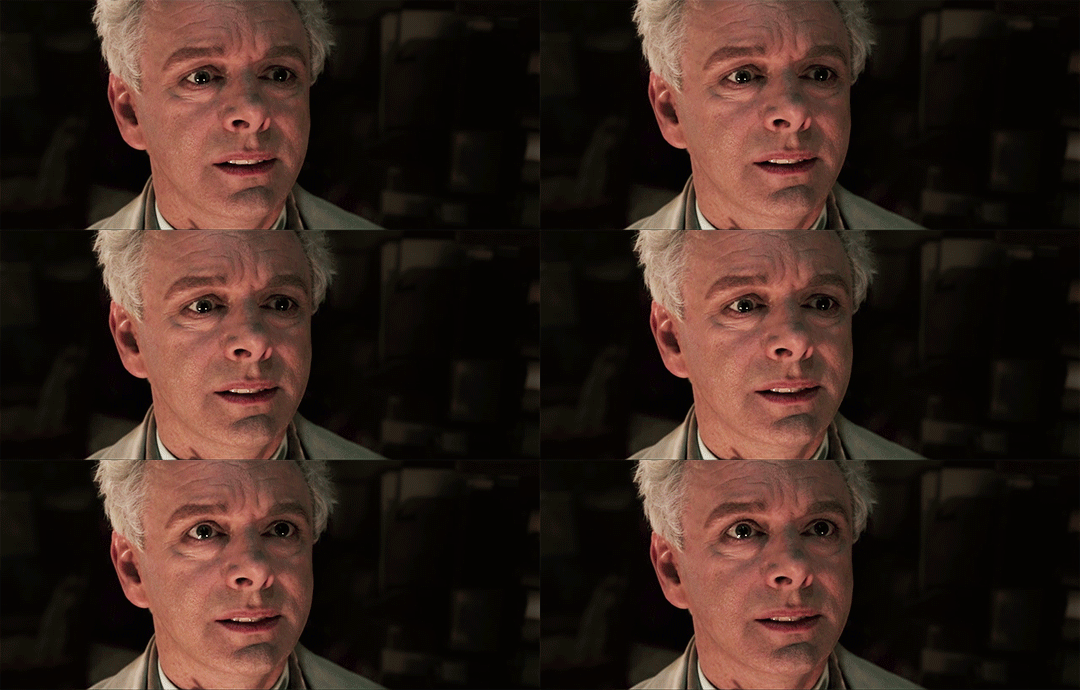
Aziraphale is my childhood. My former self. I love him deeply. He loves books and is intensely worried he is doing the wrong thing. His passions are belittled and he feels like he has to conform to the rigid order set for him. He has his little rebellions: a chaos of a bookstore filled with humanity as an escape from the sterile environment of heaven, his penchant for earthly pleasures like food and music and dance, and his relationship with Crowley.

But even those deviations are not enough for him to see that the structure to which he has held himself is not, in fact, "good." He keeps seeking the good in it, having faith that someone up there knows what they are doing. Then, incrementally, his faith in the system gets chipped away. He keeps trying to connect, until finally he stands up to the quartermaster angel and says he has "no intention of fighting in any war." He has realized that heaven and hell are not "good" and "bad." They are just two flawed sides. He learns to trust himself and his inner compass. And that does not preclude still believing in God. He still mentions Her in the park bench scene after the apocalypse is averted. He just doesn't need the heavenly structure to prop it all up anymore.

I struggle with perfection. Much of my life was built around what I "should" be doing or what others expected of me. Part of that, I think was due to the inherent pressures of Catholic ideology and of the unintentionally fixed mindset of 90s education. There was a way to do things. You stay on the path. You get good grades. You do not question authority. Part of my internal structure was built from scars left by an emotionally damaging childhood friend who made fun of what I liked and how my brain worked. Part of the structure, too, was something that I built in my life to keep the chaos at bay, which I will get into when I talk about Crowley.
As I get older, I am beginning to see that those old structures no longer serve me. That life is messier, but often so much better, when you color outside the lines. And that the world is not black and white.
Aziraphale is described as "soft." It is the best part of him. He is compassionate, yielding, and cuddly. As a person who felt so much pressure to be a warrior, to have my beloved angel be soft, and have that be ok, was a balm to my ever striving, ever guilty soul. I can be soft and free and love what I love and still have faith in Her.

Crowley is my precious current Chaos Muppet disaster self. And perhaps I always was Crowley. I just didn't allow him to peek out. I built structures around him because I didn't know how to handle that much anarchy. I was surprised when I watched the show that my heart was calling to Crowley rather than Aziraphale. I am a librarian after all. But I was drawn towards this mess of a former angel. Unlike Aziraphale, he doesn't hold to the party line. He follows his heart, his inner compass, and sometimes that leads him astray. But sometimes it leads to something beautiful and true. Logic be damned. And he asks questions. Why are things the way they are? Do they have to be? What if we made something better and different with pieces of what is good. Why do we have to stay in this structure if it will lead us to our doom?
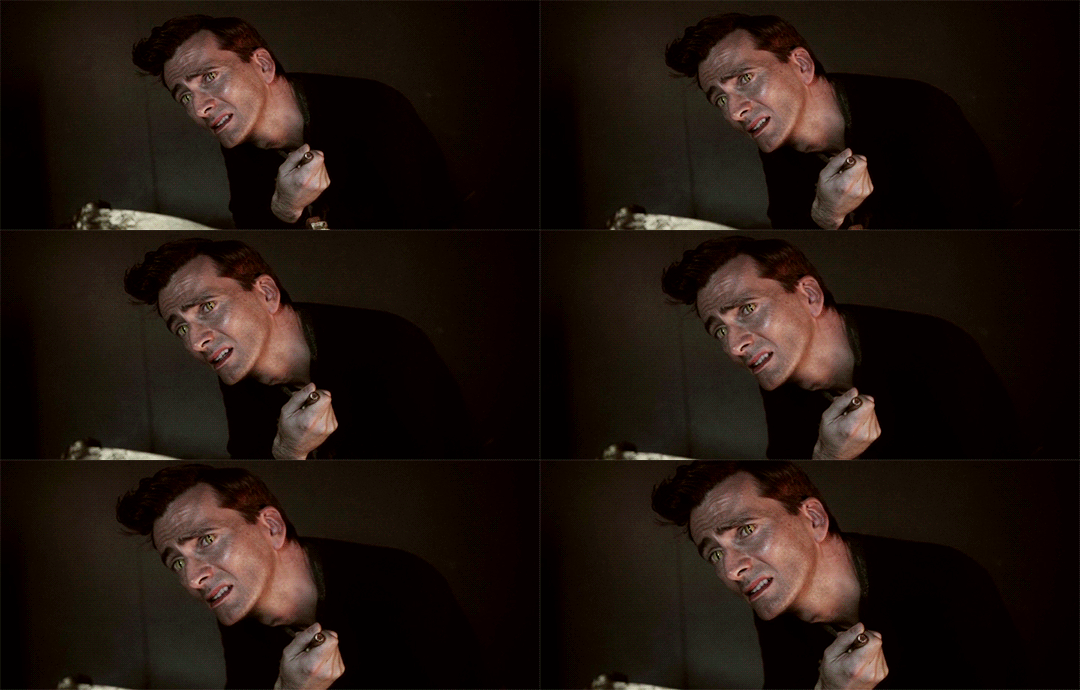
This is where I am. Grey areas. Questions. Following my heart. And sometimes it is a big old disaster. And sometimes it leads to something beautiful. Crowley is comfortable living in that state of risk, something I am only beginning to develop.
In the past few years, I have been diagnosed with anxiety and ADD. I unconsciously built a lot of my internal structures to box away these things before I knew what they were, and have only recently begun the process of integrating them into who I am. With anxiety, I periodically get paranoid and uncertain and question my worth and my relationships. On one of my rewatches, I realized that Good Omens had given me a language for anxiety and a coping mechanism to help: Crowley in the burning Bentley.
Crowley drives his beloved car through a wall of flame and miles beyond because he knows that he needs to stop the end of the world. He has something important to do. He is scared. But he holds the car together with grit and imagination. Because he needs to. Because something is more important.
When I feel anxiety, it often feels like I am driving a burning car. Every act is 100 times more difficult. It is like fighting through a storm. But Neil Gaiman said Crowley had imagination. And if there is one thing I have, it is that. Previously, I felt that "imagination" was a bit floofy and abstract, not a skill you would put on a resume, but really it is the best superpower in the world. I can believe anything. I can use my superpower to believe that I am fine. That I can function when something I have to do is more important than my burning mind.

With ADD, I went through several waves of emotion when diagnosed. The first was relief that I had a name for it. My impulsiveness and distractability and paralysis at huge projects were not moral failings. My brain just didn't have a manager telling the various parts of my mind what to prioritize. The second phase was turmoil. I am broken. I am chaotic. I do not have the skills I need to function. I am now moving beyond that into brain hacking, finding ways to trick my mind into doing what I want. Much like writing this very long essay to give my Good Omens love somewhere to go. I often imagine those were Crowley's stages as he fell. "I identify with this group. I have a name for what I feel." "I am broken. I am fallen. I am unworthy." "I am going to make this work."
I am also learning how and when to let the chaos play, because often it is where I get my best ideas. Crowley (and Aziraphale too) became the embodiment of that chaos in all the best possible ways. Just listen to this exchange between my two beloved entities at St. James' Park:
Crowley: (deadly serious) I need insurance. For if it all goes pear-shaped.
Aziraphale: (throws bread at a duck and sighs, sadly and wistfully) I like pears.
Crowley: I wrote it down. (hands Aziraphale a note) Walls have ears. Well, not walls. Trees have ears. Ducks have ears.... do ducks have ears? Must do. That's how they hear other ducks.
Then, they return to their very serious conversation. Their minds hop to fleeting thoughts, like mine does, and they follow each other down these flights of fancy, dancing together until they return to the matter at hand. It was so nice to see that reflected in a show and just accepted.
Crowley is a mess. He is chaotic and impulsive. He will never admit it, but he has buried trauma from being rejected from heaven ("Unforgivable, that's what I am." "Say good bye to your friend. He just couldn't cut it.") But he tries. And he loves. And we love him for it. As a person who struggles with perfection, this is precious. You can be flawed and still be loved. You can be flawed and still be worthy. And it doesn't mean that you stop striving to find goodness and truth in the world. But you don't have to be paralyzed by trying to be perfect. You can screw up and be forgiven and try to do better next time.

Crowley and Aziraphale's relationship is also incredibly important to me. They have different ideologies and modalities. Yet the love each other. They challenge each other. They make each other better. They also do not express their love in the ways that society teaches us to expect. As someone who finds herself more on the biromantic demisexual end of spectrums, it was so important to see a couple that didn't have sex as the ultimate endgame. All they needed to do to feel fulfilled is be with each other.


There have been many other amazing conversations about representation in the fandom, and I love listening to them and learning from them. I also love reading all the fanfic exploring all aspects of this couple, from the domestic to the sexy. But having the relationship as canon and open to interpretation gives me this little corner of biromantic demisexual joy.
David Tennant and Michael Sheen


As I began to get deep into the fandom, watching interviews, seeing their tweets, they became rolled into my obsession. I started to pick apart why. I realized it wasn't because I wanted to be with them, like many of my friends and lots of the fandom do. I realized I wanted to be them. They are my heroes.
As I have come to embrace my anxiety and chaos, I have realized how much it often gets in the way of my relationships. It makes me incredibly selfish and focused inward. The pain that I am feeling. The turmoil I am in. And I am conscious at times of being callous or unintentionally harmful to others.
And then I see Michael and David. And they are lovely. They have a lot of insecurity like me, but they are able to put it aside and be generous and kind and humble and giving. They work hard. They do their best. They put love out into the world.

And I think this is the final beat in my Good Omens processing.
This is the gift that Good Omens gave me: You are allowed. Your brain can jump around to dolphins and ducks and the Sound of Music as long as you eventually get back to talking about the impending apocalypse. You can be flawed and chaotic and still be loved. You do not have to be perfect. You just have to strive to seek the good and the true. You will stumble. And you can just get back up again, apologize, and try and fix your mistakes and move on. You can be soft, and that is not a bad thing to be. Your imagination can get you where you need to go, even if everything is on fire. You can find love in whatever form it comes to you, and there is no right way to do it. Find a partner that compliments you, that challenges you, that will hold your hand at the end of the world. And in the end our differences make us better. Our differences help us see all sides and all solutions if we work together. Be kind. Be open and generous. And in the end, no matter how fucked up the world is right now, our hope lies in people.


No comments:
Post a Comment